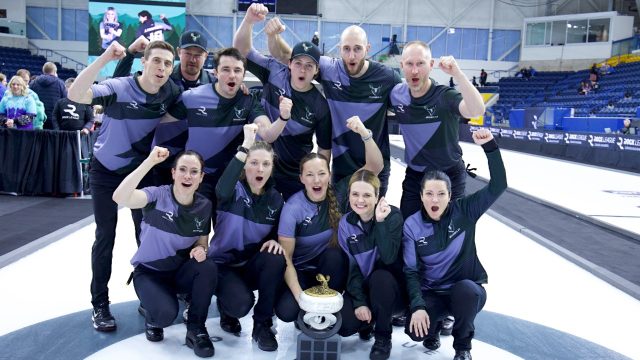
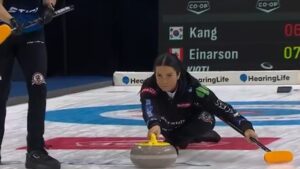
TORONTO — Captain Brad Jacobs thought the potential game-winning shot looked good, but Kerri Einarson was so worried it was heavy that the skipper covered her eyes as their Shield CC teammate, Benoit Schwarz-van Berkel, followed his rock down a wide-open Sheet A at Mattamy Athletic Centre.
“It was running — he wasn’t touching it, so I was a little nervous,” Einarson said of her Swiss teammate’s attempt to draw the button.
Nail it, and their 11-person team made up of players from Canada, Switzerland, Italy and Sweden would share a US$100,000 winner’s cheque and be the first-ever Rock League champions, winners of an event that saw some of the world’s best curlers play with rules and elements the sport has never quite seen before as six franchises with GMs went head-to-head in men’s and women’s fours and mixed doubles.
It was a fitting way to end the first event for the outfit that promises to present “Curling Unleashed,” too, that the week-long competition came down to a draw to the button between two curlers. After Jacobs beat Typhoon CC’s Niklas Edin in men’s and Einarson lost to Typhoon’s Anna Hasselborg in women’s, mixed doubles was the deciding game to determine the event’s champion. Since the mixed doubles game was all tied up through eight regulation ends, Rock League rules state that ties are broken by a draw to the button challenge, and so after Typhoon sent theirs long, Schwarz-van Berkel got set in the hack to try to float in the winning shot.
“Of course, you feel the atmosphere is changing in the stadium,” he said, with a grin, since all his teammates were watching, along with some 500 fans in the stands. “That was exciting. You just want to throw it as good as you can.”
Schwarz-van Berkel did, and when his shot settled on the button, he and the rest of Shield CC were airborne, hugging and jumping and fist-pumping as Queen’s We Are the Champions played over the arena’s speakers.
“It felt good,” Schwarz-van Berkel said, holding a hammer trophy he’d won after being named the event’s MVP, which comes with a US$5,000 prize. “So very glad I could make it,” the 34-year-old from Geneva added, thinking of what it would’ve been like if he hadn’t. “That would be, I mean, a bummer. So very glad.”
Jacobs, who back in February won his second Olympic gold medal, was all smiles as he reflected on Rock League’s debut event.
“What a great way to end the week,” he said, pointing out that was the best part of all, on top of the winner’s cheque. “We wanted to be crowned champions and be the first ones to win in this league. Obviously it doesn’t hurt to make some extra cash — we’ve got mouths to feed and roofs to keep over our heads and all that stuff. But to be the first ones, you know, more than anything, there’s no feeling like winning.”
Shield CC was Canadian-heavy, with not only Jacobs and Einarson but fellow Canucks Tracy Fleury, Jacob Horgan, Dan Marsh and Marlee Powers. They were joined by Switzerland’s Schwarz-van Berkel and Carole Howard, Italy’s Mattia Giovanella and Amos Mosaner, and Sweden’s Agnes Knochenhauer.
“They made it really easy,” Jacobs said, of his teammates, and creating a good dynamic. “I think everyone’s very cooperative, genuinely good people, and when you combine that with the athleticism, the hard work everyone puts in, and just seeing the personalities and everyone getting along really well, I wasn’t surprised to see that we were doing well this week. And I’m not surprised to see us come out with the win because of that.”
Schwarz-van Berkel said he figured franchises would start practising together ahead of events going forward, with a full Rock League season kicking off in January of 2027, featuring five events across North America.
“It’s a very different end to the season, winning the first edition of this. Hopefully it’s a concept that’s gonna grow and become relevant,” Schwarz-van Berkel said. “That feels very good today, and hopefully in a couple of years, you will be even more proud because the league has grown and, you know, the attention and the meaning of it will grow.”
The league declares “the future of curling is here,” and it boasts a non-traditional product that features different elements, like a rink-side bar and a live band playing between games. But the biggest differences are in the rule and format changes: It’s faster (players have about 80 per cent of the thinking time they get at other events and four-person games go just seven ends), it’s head-to-head (ten-player franchises feature men’s fours, women’s fours and mixed doubles all playing match-style to determine the winner), and it has different rules (like a shot on the pin hole in the final end worth two points instead of the usual one and a no-tick rule that players loved).
Jacobs said he himself, at age 40, didn’t feel like the sport’s future, but he hopes the Rock League can be a place for young curlers to aspire to play in one day. “I think that’s what they mean about 'the future of curling is here,' for young kids,” the skip said.
The Rock League saw every player earn prize money from a $250,000 total pool. Typhoon CC, led by Hasselborg and Edin, took home a shared $60,000 in second place, while the last-placed Frontier CC split $10,000.
The intensity on the ice was at its height on Sunday, players agreed, but factored in all week.
“We’re all out here to win,” Einarson said. “Amazing week for us, and pretty special to be the first-ever Rock League champs.”
“Certainly going into the summer, it’s nice to be the team that wins the last game,” Jacobs added.

 1:22
1:22